THE BUTTERFLY COLLAPSE ORMUZ

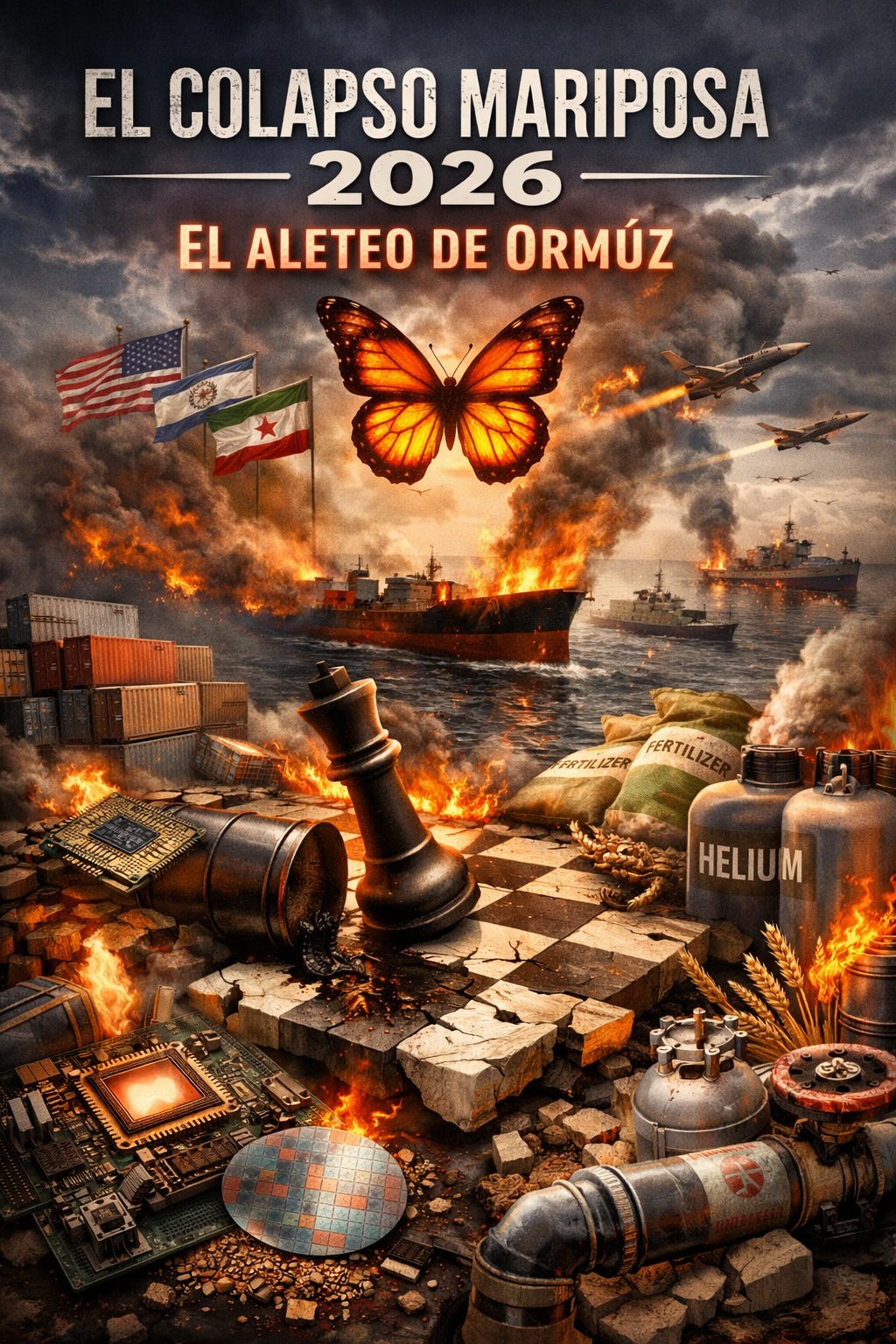
April 2026, in spanish in : https://colapsistas.com/el-colapso-mariposa-ormuz/
Five years have passed since I wrote about the “butterfly collapse,” that uncomfortable idea that we live in a global system so interconnected that a small disturbance in a specific point can trigger a cascade of consequences on a planetary scale. Back then, we talked about droughts in Taiwan, microchips, snowstorms in Texas, or tensions around the Nile. It felt like a theoretical exercise, almost academic. Today, it no longer is.
Today, the flap is not a butterfly. The flap is the Strait of Hormuz.
The Strait of Hormuz is not just a strategic point on the map; it is one of the main valves of the global industrial system. A critical portion of the world’s energy flows through it, but reducing its importance to oil alone is missing the point. What is happening in the war involving Iran, the United States, and Israel is not just a regional conflict; it is a direct disruption of one of the arteries that feeds the entire global economy. When that artery is blocked or degraded, it’s not just energy that stops flowing—the whole system begins to stall.
The most visible impact is energy. Sharp increases in oil prices, market tension, uncertainty, contingency plans. But that is only the first symptom, the most superficial one. The real problem is not the price of a barrel of oil, but everything that depends on it. Energy is not just another sector; it is the foundation upon which everything else stands: transportation, industry, agriculture, technology. When energy becomes more expensive or constrained, every gear in the system starts to strain. That is where the butterfly effect truly begins.
One of the first serious impacts appears in fertilizers. Modern agriculture depends entirely on them, and a significant portion of their production and distribution is tied to that region. When the flow is disrupted, we are not talking about an immediate shortage in supermarkets, but something far more dangerous: the breakdown of future production. If fertilizers do not arrive today, harvests months from now will be smaller. And when that happens, there is no quick fix. The outcome is inevitable: lower agricultural output, rising prices, and in many countries, social instability.
This is one of the most common mistakes when analyzing these crises: thinking about the present instead of understanding time delays. Collapse does not happen when shelves are empty; it happens much earlier, when the input that made those products possible fails.
But if there is a perfect example of systemic fragility, it is helium. A completely invisible resource for most people, yet absolutely critical for the technology industry. Without helium, semiconductors cannot be manufactured. It is not optional. And a key part of the global supply is directly linked to this conflict zone. When that chain breaks, the impact is not immediately visible to consumers, but it is devastating for the industrial base. Less helium means fewer chips, less technological capacity, less digital infrastructure.
The paradox is striking: the entire digital economy, including artificial intelligence, depends on highly localized and vulnerable physical resources. The cloud is not ethereal; it depends on ships, gas, minerals, and geopolitical stability. When one of those elements fails, the entire structure begins to shake.
This brings us back to microchips, but now amplified. In 2021, we talked about droughts in Taiwan. Today, the problem is no longer a single variable. It is the sum of all of them: energy, raw materials, logistics, costs, geopolitics. It is a perfect storm. And when chips fail, it is not just one sector that suffers—the entire modern industrial system does. Automotive, telecommunications, defense, banking, consumer goods… everything depends on them.
From there, the disruption spreads as a chain reaction. Rising shipping costs affect all goods. Shortages of oil derivatives impact plastics and chemical products. The lack of certain materials halts production lines. And each stoppage triggers another somewhere else in the system. This is not a single crisis; it is a network of failures feeding into each other.
Europe, as usual, tries to respond with emergency measures, but the problem is structural. You can have gas reserves or diversify energy sources, but that does not protect you in a globally interdependent system. You may have electricity, but if you lack fertilizers, components, or raw materials, your economy remains vulnerable. In this context, self-sufficiency is largely an illusion.
This is where the concept of the butterfly collapse fully reveals itself. We are not facing a single event, nor a sudden, spectacular breakdown. We are facing something more complex and harder to manage: thousands of small disruptions happening simultaneously, interconnected, amplifying each other. A ship that doesn’t arrive, a factory that stops, a missing input, a price spike, a broken chain.
The mistake is to keep thinking in linear terms, as if every problem had a single cause and a single consequence. The reality is that we live in an extremely complex network where each node depends on many others. And when a critical one fails, it does not fall alone.
In 2021, the butterfly collapse was a warning. In 2026, it is a process already underway. There is no single butterfly. There are millions. And they are not acting in isolation—they are flapping all at once.
The Strait of Hormuz is not the origin of all problems, but it is one of those points where the fragility of the system becomes undeniable. It is where a local disturbance turns into a global disruption. And the most unsettling part is not what has already happened, but what is already in motion and still unseen.
Because real collapse does not happen when everything suddenly stops. It happens when things stop working the way you expect… and there is no way back.